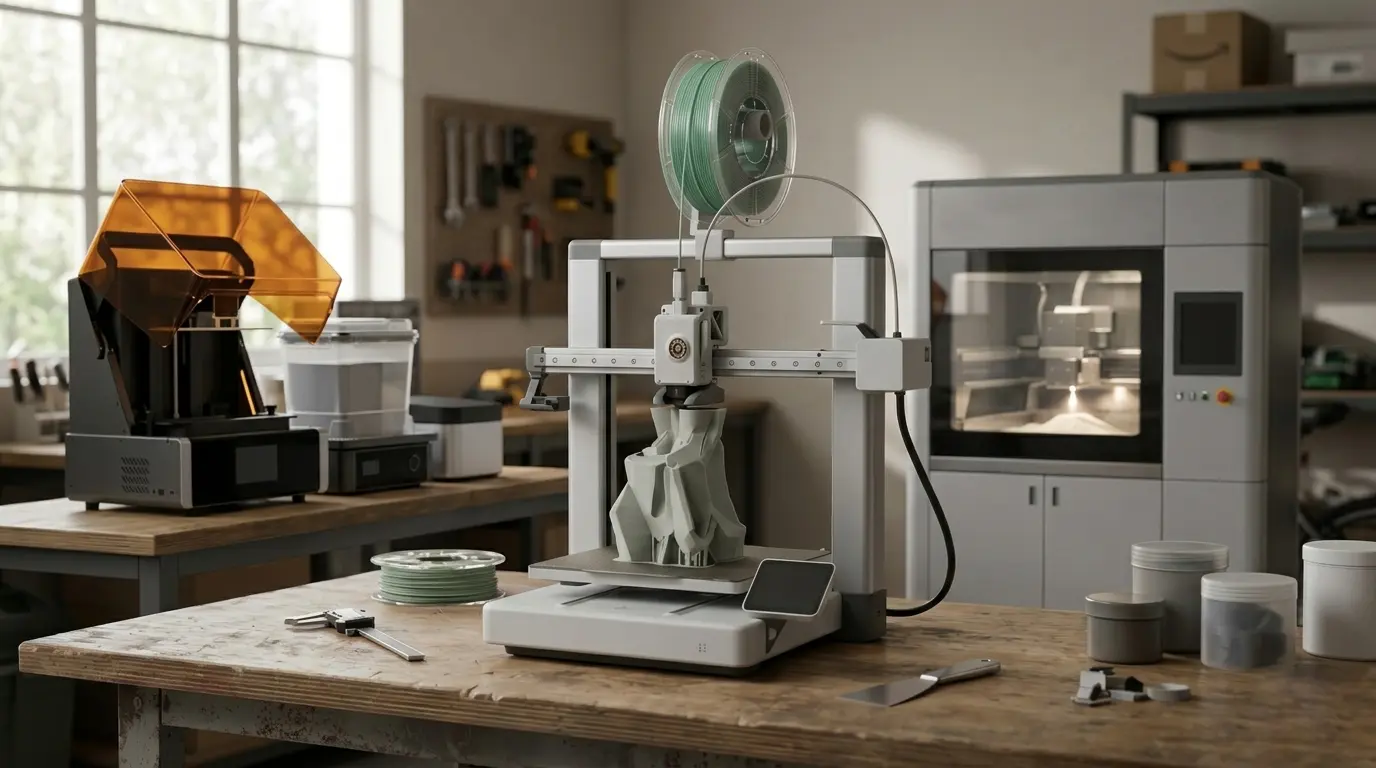
The 2026 3D Printing Era: When Creativity is No Longer Exclusively for Engineers!
Do you remember back in the 2010s, when mentioning a

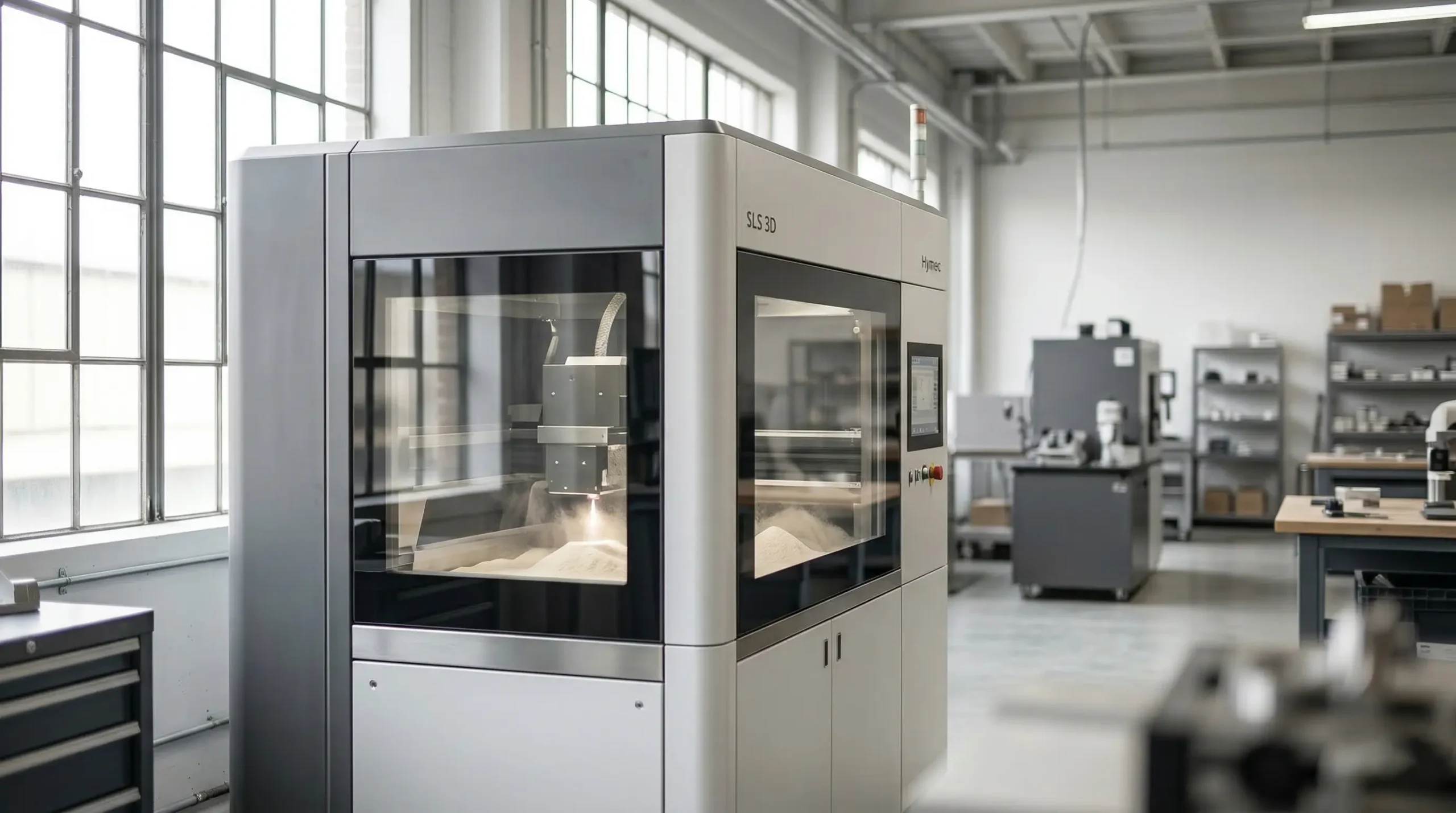
While desktop 3D printers are taking the market by storm with decorative models, SLS (Selective Laser Sintering) 3D printing is quietly dominating the manufacturing floors of functional, real-world components. If you are looking for a technology that can produce parts capable of withstanding heavy impacts, high temperatures, and complex structures, this article is your key.
SLS 3D printing is a selective laser sintering technology that uses a high-power laser to fuse ultra-fine polymer powder particles into solid objects. Unlike FDM (filament printing) or Resin-based technology, SLS does not require support structures. The unsintered surrounding powder acts as a natural “scaffolding” for the object inside.
Powder Coating: A recoater blade spreads a thin layer of powder across the build platform.
Sintering: The laser scans the cross-section of the component, binding the powder particles together.
Repetition: The build platform lowers, and the process repeats until the object is complete.
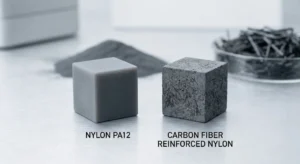
The reason this technology is so highly valued lies in its material ecosystem. We are not just talking about “prototypes”; we are talking about “end-use parts.”
Nylon is the most common material in SLS 3D printing thanks to its excellent mechanical strength and high wear resistance.
Properties: High thermal resistance, excellent toughness, and strong chemical resistance.
Applications: Device enclosures, fuel tanks, or load-bearing joints in machinery.
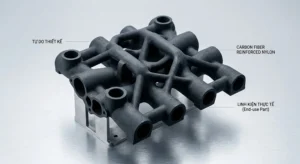
By blending carbon fiber into Nylon powder, we create a material that is ultra-lightweight yet possesses a rigidity comparable to certain lightweight metals.
Pros: Extremely high stiffness-to-weight ratio and excellent dimensional stability.
Applications: Racing car components, aerospace parts, and high-end sports equipment.
Why are businesses willing to invest in expensive SLS systems instead of traditional manufacturing methods?
Design Freedom: You can print complex internal hollow structures or interlocking parts without the need for cutting, machining, or assembly.
Optimized Output: In a single print job, you can nest and stack hundreds of different components inside the build chamber to maximize space efficiency.
Isotropic Mechanical Properties: SLS prints exhibit consistent physical and mechanical properties in all directions (isotropic), making them less prone to layer separation compared to FDM printing.
Despite its many advantages, this technology still requires strict operating procedures and a substantial initial investment.
After printing is complete, the powder cake requires time to cool down. Cleaning off excess powder and treating the surface (such as sandblasting or dyeing) are mandatory steps to achieve a refined finished product.
SLS printers require proper ventilation systems and strict powder management protocols to ensure the health and safety of the technicians.
SLS 3D printing is no longer a luxury technology reserved only for prototyping. With the combination of Nylon powder and Carbon Fiber, it has officially entered practical production lines, helping businesses shorten their time-to-market. Whether you are a mechanical engineer or a business owner looking for an optimized manufacturing solution, SLS is undoubtedly an indispensable piece of the Industry 4.0 revolution.
SLS technology is the premier solution for industrial, load-bearing parts with complex geometries. However, if your project has different priorities regarding budget or surface finish, consider the following alternatives:
If you need an economical solution for everyday items: When the industrial durability of SLS is more than required and you need a more budget-friendly option for basic prototypes, FDM 3D Printing Technology is the go-to standard. FDM is perfectly suited for printing household items, simple components, or large-scale models at a very low material cost.
If you need absolute smoothness and ultra-fine details: SLS features a slightly matte, textured surface characteristic of sintered powder. If your product demands a sleek, glossy finish without visible layer lines—such as jewelry, dental models, or character figures—choose SLA 3D Printing Technology. Utilizing liquid resin and a UV light source, SLA creates masterpieces with a level of sharpness that makes them almost indistinguishable from injection-molded parts to the naked eye.
Understanding the unique strengths of each technology ensures you select the right “weapon” for your project, guaranteeing both aesthetic appeal and functional performance.
Do you remember back in the 2010s, when mentioning a

Architects of the Future: Infusing Living Spaces with Artistry Through