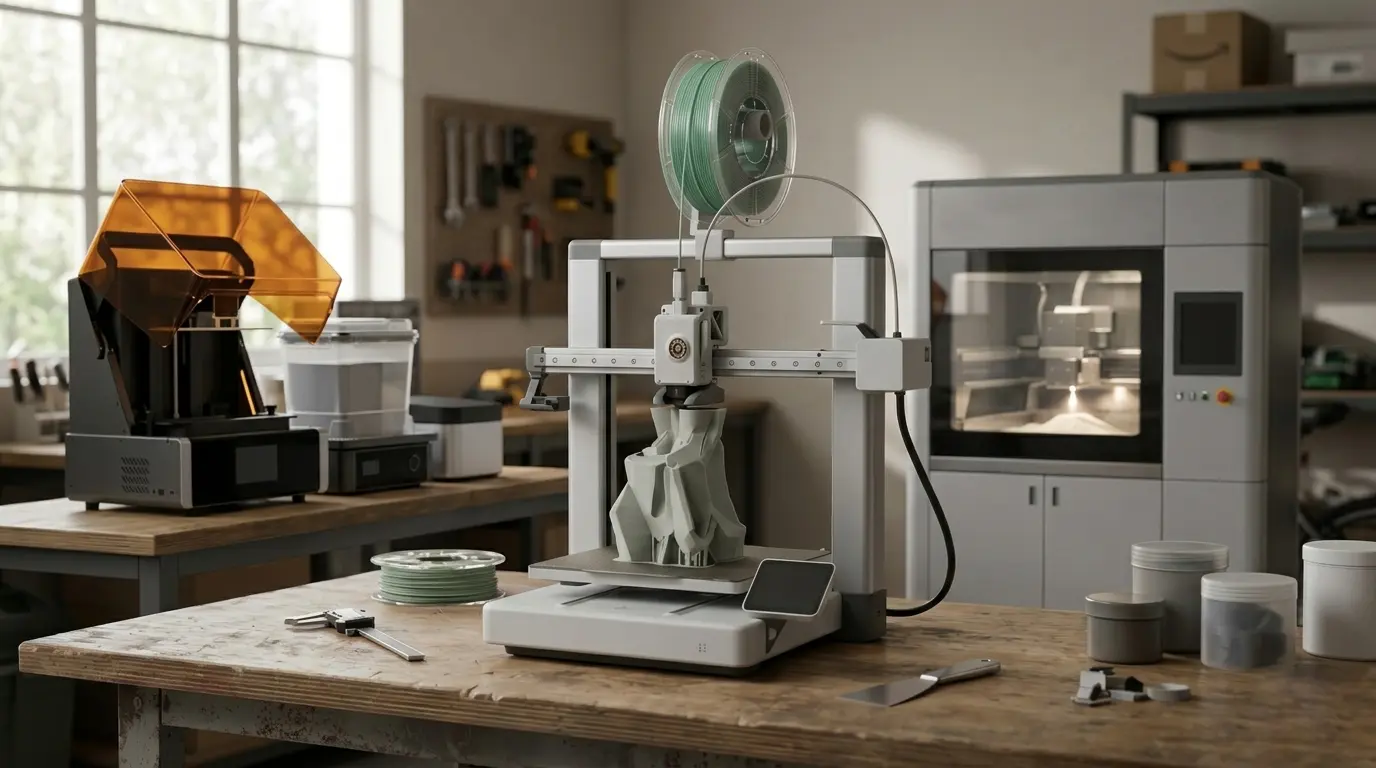
The 2026 3D Printing Era: When Creativity is No Longer Exclusively for Engineers!
Do you remember back in the 2010s, when mentioning a


Resin 3D printing (SLA/DLP/LCD) is rapidly becoming the gold standard for anyone seeking precision down to the single micrometer. However, standing before the “matrix” of liquid material choices can easily leave you confused. This article will help you decode the world of 3D printing resins, from standard lines to high-tech specialized engineering resins.
3D printing resin (or photopolymer) is a liquid material that hardens when exposed to a light source of a specific wavelength (typically UV light). Unlike FDM technology, which uses heated thermoplastic filaments, resin printing technology utilizes an LCD screen or a laser beam to “draw” each cross-section layer onto the liquid surface, creating finished products with exceptionally smooth surfaces.
Ultra-High Detail: The ability to reproduce tiny features that filament-based printers can never achieve.
Sleek, Glossy Surface: Layer lines between print slices are virtually invisible.
Diverse Applications: Ranging from jewelry making and dental applications to character figures.
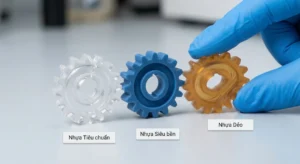
To choose the right material, you need to understand the mechanical properties and intended purpose of each resin family. Below are the three main groups that any 3D printing enthusiast needs to know.
This is the most common resin type, perfectly suited for beginners thanks to its affordable price and ease of printing.
Characteristics: High rigidity but relatively brittle; prone to snapping or breaking under heavy impacts.
Applications: Display models, non-load-bearing visual prototypes, or decorative items.
If you need a print that can withstand impacts or be used for mechanical assemblies, tough resin is the number one choice.
Characteristics: Possesses a certain level of toughness and elongation; can withstand stress and collisions without cracking or fracturing immediately.
Applications: Electronic device enclosures, mechanical joints, and replacement components.
This family of resins delivers properties similar to rubber after undergoing proper UV post-curing.
Characteristics: Capable of stretching, flexing, rebounding, and offering excellent shock absorption.
Applications: Gaskets, tool handles, or models requiring structural flexibility.
Not every resin performs well on every printer. You must pay close attention to the following technical specifications:
Light Wavelength: The vast majority of resins today are optimized for a 405nm wavelength, but always double-check the specifications of your specific printer.
Exposure Time: Specialized resins (such as flexible variants) typically require longer exposure times compared to standard resins.
Shrinkage Rate: Some low-cost resins suffer from a high shrinkage rate, which can warp or distort the dimensions of technical, high-tolerance prints.

Working with liquid resins requires a high level of caution to protect your health and maintain the quality of the material.
Always keep the bottle tightly sealed and store it away from direct sunlight.
The ideal room temperature for printing and storage generally ranges from 20°C to 30°C.
Thoroughly shake the resin bottle before pouring it into the vat to ensure pigments are homogeneously mixed.
Wear Nitrile Gloves: Absolutely never let liquid resin come into direct contact with your skin.
Masks and Ventilation: Resin often emits a pungent odor; always work in a well-ventilated space.
Waste Disposal: Liquid resin waste must never be poured directly down the drain. It must be exposed to sunlight to cure and solidify completely before being disposed of as standard trash.
The world of 3D printing resin is highly diverse and full of potential. Understanding the differences between standard, tough, and flexible resins will help you optimize your workflow and create the most flawless products. Start with standard resin to familiarize yourself with the process, then challenge yourself with engineering lines to witness the true power of liquid 3D printing technology.
SLA technology is the “king” of fine detail. However, if your project prioritizes mechanical durability or cost optimization for large-scale objects, you can consider these two powerful alternatives:
If you need durability and cost-optimization for functional prototypes: When surface smoothness is less critical than load-bearing capabilities and material variety (such as heat resistance or elasticity), FDM 3D Printing Technology is the perfect alternative. FDM allows you to print large components at a fraction of the cost of resin, while being much easier to handle and deploy immediately.
If you need to manufacture industrial components with zero geometric limitations: If SLA is too brittle and FDM lacks geometric complexity, look into SLS 3D Printing Technology. Utilizing the power of a laser to sinter polymer powder, SLS requires no support structures, allowing you to create nested moving assemblies or parts that endure extreme punishment in harsh industrial environments.
Understanding the unique strengths of each technology ensures you select the right “weapon” for your project, guaranteeing both aesthetic appeal and functional performance.
Do you remember back in the 2010s, when mentioning a

Architects of the Future: Infusing Living Spaces with Artistry Through