
The 2026 3D Printing Era: When Creativity is No Longer Exclusively for Engineers!
Do you remember back in the 2010s, when mentioning a


Navigating the vibrant universe of modern manufacturing requires a deep, strategic understanding of your raw materials. Achieving a flawless, professional-grade physical object depends entirely on matching your specific mechanical goals with the correct FDM 3D printing filaments. Selecting the wrong chemical compound can instantly cause structural warping, brittle layers, or costly print failures that waste your precious workshop hours. Conversely, mastering these material properties unlocks a stunning realm of absolute design freedom, letting you fabricate everything from rugged functional machinery parts to elegant, intricately detailed artistic home decor.
To choose the right material, you must clearly define the environment in which your product will be used and the impacts it will face. Below is a detailed analysis of the top 4 3D printing filaments.
Identification: Glossy surface, rigid, emits a pleasant slight scent during printing, and comes in a wide variety of colors.
When your primary manufacturing objective focuses on crisp visual details and effortless execution, deploying premium PLA stands as the absolute smartest choice. Derived from renewable resources like cornstarch or sugarcane, this eco-friendly thermoplastic is universally celebrated as the most accessible material in the desktop community. It requires zero heated printer enclosures, shows almost zero structural shrinkage, and emits a highly pleasant, sweet scent during the entire fabrication cycle. This user-friendly nature makes it the premier choice for crafting complex architectural models, highly detailed character figures, and educational prototypes right on your desk.

Identification: Matte, textured surface, highly rigid and tough, emits a pungent odor during printing. It can be dissolved in Acetone for surface smoothing.
For independent creators and industrial engineers who need to fabricate high-strength, impact-resistant mechanical components, transitioning to rugged ABS is completely non-negotiable. This powerful engineering plastic delivers spectacular thermal stability and physical toughness, making it the ideal candidate for protective electronic enclosures and functional joints. However, mastering this material requires a closed printer chamber to prevent severe warping caused by rapid temperature fluctuations. A brilliant hidden advantage of this compound is its chemical solubility in acetone, allowing you to effortlessly fuse layers together for an ultra-smooth, mirror-like surface finish.

Identification: Typically features a slight transparency, a very glossy surface, and excellent interlayer adhesion.
If your upcoming project demands a perfect, high-performance balance between printing simplicity and industrial-grade durability, look no further than PETG. Widely recognized as the ultimate sweet spot of the manufacturing world, it inherits the effortless printability of cornstarch plastics while retaining the weather resistance of heavy-duty engineering polymers. Its exceptional interlayer adhesion, natural UV protection, and waterproof capabilities make it the supreme choice for outdoor items like custom flower pots and automotive brackets. When utilizing certified food-safe resin grades, it also serves as an excellent option for custom kitchenware and durable organization trays.

Identification: Rubber-like, flexible, bendable, and highly resistant to tearing.
When your structural designs completely reject rigid boundaries and require absolute elasticity, integrating flexible TPU will completely transform your workflow. Belonging to the specialized elastomer family, this remarkable rubber-like material allows your finished products to stretch, bend, and absorb heavy impacts before rebounding perfectly back to their original shape. It serves as an irreplaceable solution for manufacturing high-tactile phone cases, industrial machinery gaskets, and custom shock-absorbing pads. While it requires a highly precise extrusion setup to manage its flexible nature, the resulting tear-resistant durability offers unparalleled mechanical performance.
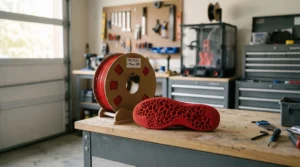
To give you a quick overview, here is a comparison chart of the most critical parameters:
| Property | PLA | ABS | PETG | TPU |
| Printing Difficulty | Very Low | High | Medium | High |
| Impact Resistance | Low | High | High | Very High |
| Heat Resistance | Low (60°C) | High (100°C) | Medium (80°C) | Medium |
| Shrinkage Rate | Very Low | Very High | Low | Low |
| Odor During Printing | Sweet/Pleasant | Strong/Pungent | Odorless | Odorless |
Filament selection should not be based on personal preference, but rather on the technical requirements of the final product.
Based on Use Environment: If your product is frequently placed outdoors under intense sunlight, prioritize PETG for its UV resistance. Conversely, if the object is purely for desktop decoration, PLA is the most economical and aesthetic choice.
Based on Mechanical Requirements: For parts that require assembly and load-bearing capacity, ABS or PETG ensures the component will not crack under stress. If you need a part that can absorb shock or tightly grip another object, TPU is an irreplaceable option.
Every printing filament has its own “personality.” Mastering the unique characteristics of PLA, ABS, PETG, and TPU will give you confidence in any design and manufacturing project. Always begin by testing with a small amount of material to find the optimal print parameters for your specific equipment.
While FDM is an excellent choice for common projects, sometimes your technical requirements may exceed the capabilities of thermoplastics. Depending on the nature of your project, you can also consider:
If you need ultra-high detail and a sleek surface finish: When FDM layer lines still lack the refinement required for jewelry, dental models, or miniature character figures, look into SLA 3D Printing Technology. This solution uses a laser to solidify liquid resin, delivering precision down to the millimeter.
If you need industrial-grade materials for complex components: For projects demanding absolute mechanical strength, multi-directional load-bearing capabilities, or automotive component manufacturing without the constraints of support structures, SLS 3D Printing Technology is the answer. SLS utilizes sintered polymer powder, allowing you to create the most complex geometric structures with industrial durability.
Choosing the right printing technology is just as vital as choosing the right filament. Carefully weigh the ultimate objective of your product to make the most accurate investment decision!
Do you remember back in the 2010s, when mentioning a

Architects of the Future: Infusing Living Spaces with Artistry Through